
Oct 31, 2017
In recent timesglobal employee percentages in business have been dominated by Millennial entrants. Training Specialists are scratching their heads about most viable technology integrated Learning Management Systems to satisfy these Digital Natives’ appetite for instant learning gratification, diversification and gamification. At the other end of the spectrum, the Baby Boomers are contemplating the options of retirement or career extension. Although retiring Boomers pose a significant challenge to corporate sustainability with millions to exit the universal workforce in the next decade, those who decide to prolong their careers are the ones E-Learning Professionals should be concerned about.
The Baby Boomer generation grew up in a pre-technological environment with limited exposure to robotics and computerisation. Somewhere between 1970 and 1985 when this generation reached the prime of their careers, increasing automation and mechanisation shocked them into “analogue times” and they had to adapt to technology development, machine optimisation and of course Microsoft, Apple, Google and Amazon. Progressing to the 21st Century foreign concepts of digitisation, artificial intelligence and technology innovation in business, resulted in a “flight or fight” response from the majority of Boomers active in the workforce during the last two decades.
Customizing E-Learning for Baby Boomers
Boomers are naturally more resistant to change and hesitant to embrace the unknown which is the reason for their sense of apprehension often displayed towards new technologies and alternative training mechanisms of E-Learning practices. Training courses and methods of content execution must be developed with the aim of easing and not forcing them into unfamiliar learning territories. Furthermore, participation and engagement of a senior audience may be substantially increased if the study material and subsequent learning activities appeal to their strengths, as opposed to exposing their weaknesses.
Offer them a challenging experience with an end goal to be achieved. The Boomer Generation is motivated by challenges, milestones and goals. Course materials incorporating assessments, “to do” tasks and purposeful learning outcomes will cultivate a sense of accomplishment and actualisation.
Automation and self-directed learning does not resonate well with this older crowd. Including “student to trainer” and “student to student” collaboration activities like branching scenarios, will encourage them to immerse themselves in the content provided.
Keep E-Learning course navigation straightforward and instinctive. Deliver sufficient technical assistance using online forums, FAQ pages, troubleshooting guides and contact forms as Boomers are not as tech savvy in comparison to the younger generations.
Although this generation is independent and self-assured, they still require praise and acknowledgement for their efforts. Creating leaderboards or rating pages will appeal to their sense of self-worth and competitive nature. Be cautious with public feedback mechanisms and rather customise communication channels for criticism to be given privately.
A double edge sword: Why E-learning for Baby Boomers matter?
One may debate the importance of adapting E-Learning strategies for the Boomer Generation as perhaps like “an umbrella after the rain” because even those opting to prolong their careers will be lost to the business environment within the next two decades. So why even bother?
Yes, maybe not the longest period to make an effort, but still it is 20 years of opportunities to upskill, develop and improve the competence of this generation to add value and stability to business. Tailoring E-Learning strategies to leverage on their fortes is crucial to ensure effective outcomes and positive results.
“The Baby Boomer Generation is hardworking, disciplined, goal orientated and thrives in challenging environments.”
Ever wondered who will be training the Nexters in 20 years from now? Probably the Millennials, correct? Now, who is teaching the Millennials at the moment? Generation X is currently in the trenches trying to keep the global economy afloat and steer corporate ships through turbulent waters of recessions, wars, climate change, volatile markets and political instability. It is time to call on the “Silver Foxes” to transfer their knowledge and experience to the M-Leaders of the future.

“Teach the Digital Immigrants to train the Digital Natives by creating a Learning Loop, by customising E-Learning tools to bridge the gap between the variation in generational learning styles.”
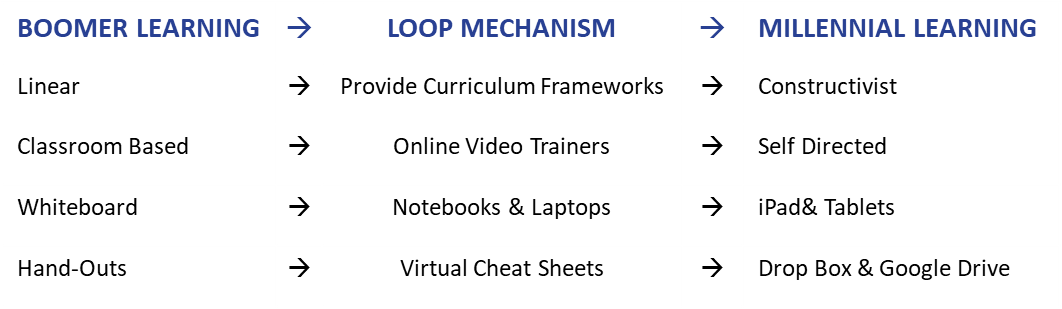
Two Birds with One Stone
Senior employees hold a wealth of valuable knowledge about the functional aspects of their jobs and vital insights into the resources, operating procedures and company dynamics of the organisations they work for. If they exit to retirement without proper succession planning strategies in place to extract and transfer their expertise, businesses may find it difficult to acclimate to the knowledge gap created by their departure.
Effectively redesigning E-Learning methodologies aimed at Baby Boomer learning, as well as the implementation of E-Learning based mentorship courses may render real economies of scale in achieving the overall Organizational Development vision of a company.

Oct 24, 2017
An age-old English proverb dating back to the 11thCentury may encapsulate one of the biggest challenges faced by E-Learning professionals today: Keeping your audience engaged in a disruptive world of distractive technologies, multitasking and decreased attention spans.
A perfectly constructed E-Learning Curriculum cannot guarantee audience participation of any sorts. The trick is to create desire and priority with learners where the importance of the content provided, trumps any other disruptive event that may transpire during the e-learning session. Distraction should not be an option. How do we then execute E-Learning content in such a manner as to fully occupy learners’ focus on what is being taught, encourage retention of information, while improving student satisfaction and enjoyment at the same time?
Controlling participant behaviour by eliminating potential distraction is perhaps an option if you could take away cell phones and smart devices during a session. However, this not often probable as E-Learning content is mostly executed via these smart devices and accessed through a cloud platform requiring… (yes you guessed it), internet connectivity to the World Wide Web aka, “the mother of all interruptions.”
Google is a treasure trove of write-ups, blogs and articles containing tips and guidelines on improving e-content, the best innovative interaction tools to use, the most enhanced animated technologies to incorporate and highly acclaimed curriculum design platforms to integrate within an LMS (Learning Management System). None of these will be useful or create a plausible return on effort if Learner Engagement is not achieved.
Catalysts contributing to Learner Engagement
All the bells and whistles of glitzy animatronics, interactive collaboration tools, gamification features, striking pictures and an attractive looking user interface cannot replace the importance of Substance as to create authentic material. Content without an impact or a Wow factor will unlikely keep learners cognitively and effectively engaged, which in turn creates no desire for learners to apply the knowledge gained to their conduct in the workplace.
Clarifying the Purpose or benefit of the training material to participants is of utmost importance. Answering the WIIFM (What’s in it for me?) question should unequivocally communicate the learning objectives to prospective participants resonating with their intrinsic motivations for learning and development. A substantial training goal must be specific, measurable and observable to learners.Professor Phil Race, from the Leeds Metropolitan University, assimilated an excellent video where he was explaining that by answering the WIIFM question, learners are far more prone to accepting content if they are consciously made aware of the advantages of putting their efforts into understanding and mastering the material.
Creating learner Anticipation continuously during the content execution process will keep participants proverbially glued to their screens. That expectation of wondering what content will be introduced next, during the session improves their focus on the material at hand and creates a desire of discovering more about the topics presented. Keith Gibson refers to this tactic as “Surprise & Delight.” Participants should perceive the given course as a fun and exciting activity, regardless of the type of subject matter introduced.
Ever wondered how a kindergarten teacher can engage a classroom full of energetic 4-year olds by fixating their eyes, ears, and minds completely onto what she is discussing? Have you seen the reaction of pre-school kids in a cinema watching the movie Frozen? They are all inspired and emotionally connected by the story being told. Utilizing Inspirational story-telling, scenario’s and analogies to bring a concept across, is a very efficient mechanism to catch and retain learner attention. An inspired learner who feels connected to the content provided will be far more likely to implement the training than a passive participant who is unable to relate to the material.
“For Learner’s sake, Make your course more Challenging”. Overcoming and mastering difficult course material creates a sense of accomplishment with learners, but making them jump through hoops with robust activities or trying tests is not the only way to achieve focus and learner connectivity. Take a page from the Facebook and YouTube success recipes to audience engagement and think about what makes certain content go viral? Viral content is most often controversial in nature with the aim of provoking reactionary comments and initiating emotionally charged debate, by challenging traditional beliefs or “schools of thought.” Encouraging “chatter” amongst your course participants by including a few left-field theories into your course material will most definitely spark conversation, ultimately leading to a more involved learning audience.
The bricks and mortar platforms of New York’s Broadway, Sydney’s Opera House, The Royal Albert Hall in London and the Russian Bolshoi Theatre, all have a single contributing factor attributing to their world-renowned status: Producing shows, plays, and events, which fully engage and captivate their audiences. The virtual platforms of the digital era offer similar opportunities to the E-Learning environment, where stellar content creation and innovative execution mechanisms may captivate a learner audience and successfully engage all course participants.

Oct 17, 2017
Artificial Intelligence, Augmented Reality, Machine Learning, Quantum Computers, Virtual Economies, Bots and Digital Automation are buzzwords of our current times. Whether referred to as The Fourth Industrial Revolution, The Age of Experience or The Digital Era, the way in which we conduct our professions are rapidly transforming and conforming around the singular beacon of Technology Innovation.
In an article by Jeff Bounds (Insigniam Quarterly, 2014), the prediction was made that the investment in Internet of Things (IoT) solutions for consumers, governments, and businesses worldwide, may exceed $6 trillion by the year 2020. Organizations will be the top adopters of IoT, focusing on strategies to improve their efficiency, productivity, and product offering.
Technology is reshaping business with Micro-and-Macro Machine Development policies directing decision-making in the boardrooms of the world, and Human Capital Advancement is perhaps often regarded as a mere channel to implement technology invention, as opposed to a tool for cultivating real human potential.
____________________________________
Contemplating the future necessity of training and learning ingenuities.
Will there be any human staff left to teach? Or is a robotized workforce trained by Artificial Intelligence closer on the corporate horizon than we may think?
According to a study by Mckinsey & Co, forty-five percent of humanized activities in the workplace can already be accomplished by technology automation. The traditional working environment is rapidly changing from man to machine and will have a tremendous impact on workforce operations, productivity, and profit.
Where would all this eventually transpire too? An imminent Matrix corporate environment directed by robots and a select few Homo Sapiens with superhuman brain power with the ability to absorb training in a matter of Nanoseconds. Perhaps we are not there yet, but for a “human working professional” certainly the stuff nightmares are made of.
Ellyn Shook, Chief Leadership and Human Resources Officer, at Accenture once stated: “Paradoxically, the truly human skills, from leadership to creativity, will remain highly relevant and winning organizations will strike the right balance – leveraging the best of technology to elevate, not eliminate their people.”
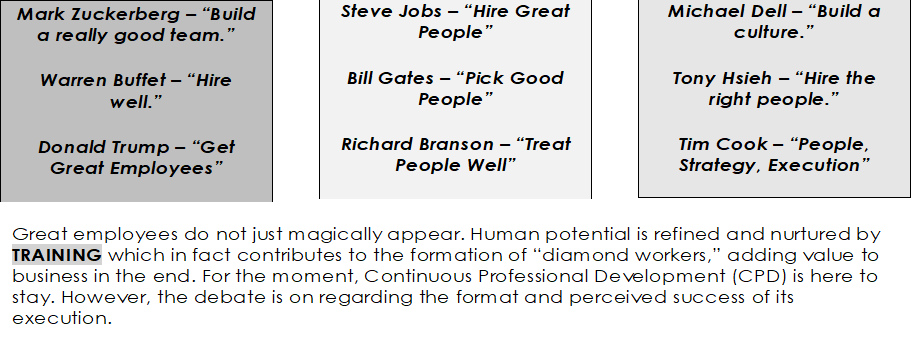
Human Capital is for the moment, is still regarded as a most valuable business asset by the Who’s Who of global business. In a Ten Rules for Success series, published by Linkedin SlideShare in 2016, the Giant Influencers of global business all cited People as an important catalyst for organizational prosperity.
Au Revoir Old School, Hello New Kid on the Block
Disruptive times call for desperate measures, and Digital Learning is widely regarded as the logical replacement to Traditional Face to Face Training and Classroom Learning. Following a Digital Learning style offers organizations the flexibility of providing on-demand learning, at a convenient time via a variety of devices to employees regardless of location and time. These practices appeal greatly to the Millennial Generation, projected to account for 75% of the global workforce by 2025.(“Millennials at Work,” PWC).
Added the significant cost saving potential of Digital Learning, adopting this method as the primary CPD strategy seems like a win-win solution for employers and employees alike. Or is this acting proverbially “penny wise, pound foolish”? Self-directed learning and around the clock accessibility of information do not ensure retention or absorption in learners. Advocates for the preservation of traditional classroom style training are raising valid concerns regarding the “stickiness” of web-based learning and the likely success rate of putting theory into practice without the aid of ILT (Instructor Led Training) activities. Learning and doing are still two very different actions the last time I checked.
Furthermore, providing employees access to online learning platforms does not guarantee completion or positive pass marks either. “Yours truly” has signed up for numerous online training courses over the years, with a sadly very negative rate of fruition. The sense of accountability created by classroom training is significantly higher than in a cloudbuilt environment.
Past, Present and Beyond 2025
Ever thought about what the state of the employee generation will be in coming 2025? Are we not creating a future workforce of digitally educated employees, but without the value of practical competence?
Traditional Training still holds water in comparison with Digital Learning when considering specific requirements, crucial to effective learning outcomes:
- Interaction & Engagement
- Personalised Feedback Channels
- Learning Objective Comprehension
- Practical Adaptation
On the flip side, Digital Learning accomplishes presently what Traditional Training was unable to achieve historically within the Continuous Professional Development industries:
- Infinite Reach
- Significant Cost Savings
- Flexibility beyond Time and Location constraints
- Economies of Scale
Jumping back from the future into the present. Today’s organizations are reminiscent of multigenerational employee compositions. A study compiled by the Harvard Business Review back in 2009 predicted our global workplace representation to include all five generations by 2015.
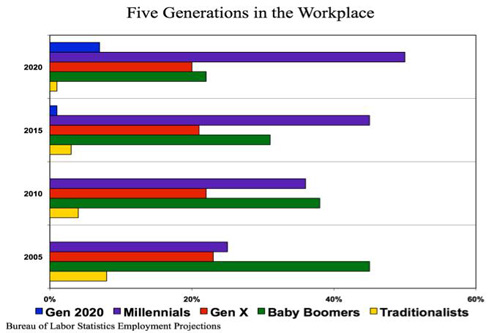
What a crystal ball moment that was! For the first time in history, we are dealing with a global workforce represented by all five generations: Traditionalists, Baby Boomers, Generation X, Millennials, and Nexters.Contrary to the popular narrative of soon to be Millennial domination, organizations are still required to cater for the other generational composites forming part of company headcount figures.
The obvious solution appears to be Blended Training: Just incorporate a multi-series of traditional and digital strategies into an LMS (Learning Management System), and you are good to go.
Not so elementary my dear Watson
The solution is not as simple as just following a hybrid training approach, but rather lies in the way that training strategies are combined and then deciding on most suitable customization in the execution thereof applicable to each generation represented within the company’s employee force.
Training professionals should fully comprehend the specific triggers of each generation in relation to their primary channels of communication and their receptiveness of information gained via these channels.
In a nutshell: How they are trained, should resonate with how they prefer to communicate and engage with others.
A Generation X-er’s addiction to email, the Traditionalist’s preference of printed communique, the Baby Boomers desire for one on one direct interaction and the Millennials need for instant messaging, constitutes for a challenging feat in learning design and delivery. Not discarding our Generation Nexters who is just starting out their careers expecting communication channels to be optimized for continuous collaboration and instant feedback.
Finding the sweet spot in generation learning preferences commonalities involves a proper identification of an organization’s own generational representations figures firstly. There is no need to reinvent the wheel to recognize what these preferential similarities are. A bit of targeted “Googling” and one stumble across excellent pieces of information summarising the training preferences per generation and specific behavioral traits to consider in the design and execution of training curriculums.
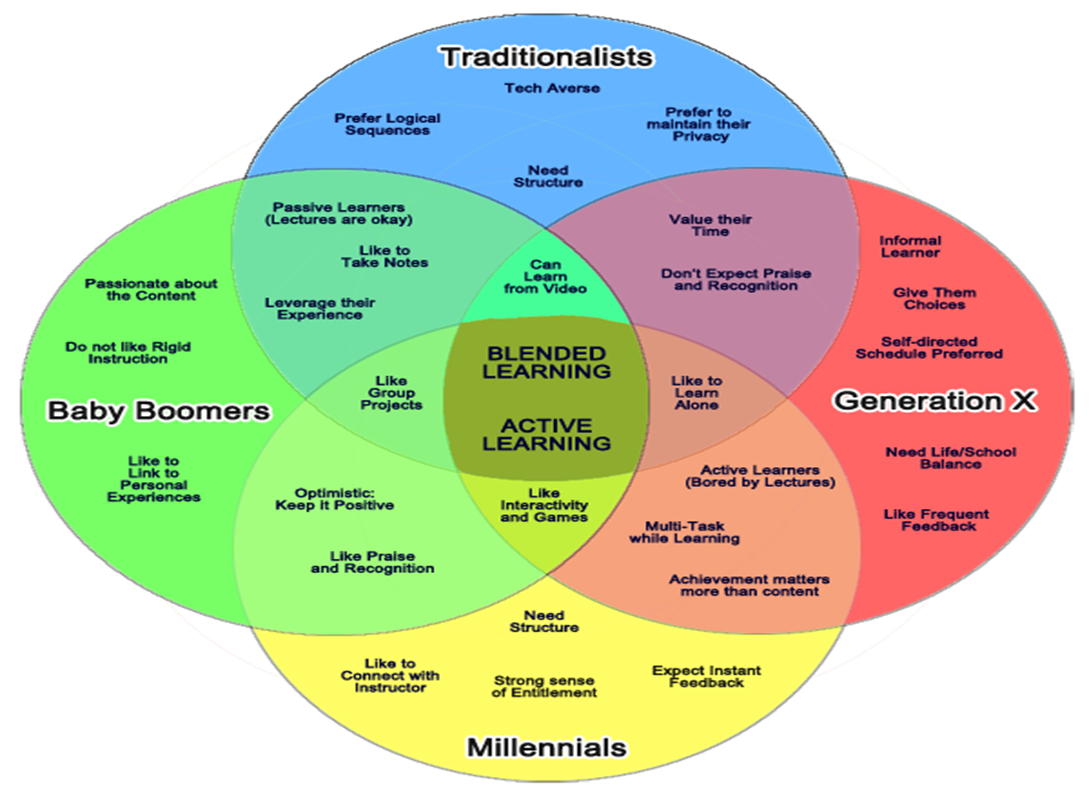
Diagram Source: Corbett, S (2008. Targeting different generations in B. Hoffman (Ed.), Encyclopedia of Educational Technology
To draw a simple example from the above figure: Traditional ILT with an online video twist or digital learning with some face to face contact may appeal to most generations forming part of your workforce. However, this is not the end of your training strategy design yet….
Listen up First World; there is a Developing World to consider too.
Factoring in employee demographics and identifying challenges pertaining to location, cultural and infrastructure barriers requires careful analysis prior to implementing learning and development initiatives. A one size fits all hybrid strategy will not be suitable if your workforce is spread across the developing nations of Latin-America, Asia, and Africa.
As a product of African origin, born on the cusp of Generation X and Millennialism, I have experienced first-hand how the anomalies evident in the various generations can blow any carefully designed training strategy out of the water. In some African countries, the Baby Boomer employees are the most Connected Generation, eager and able to partake in Digital Learning via their tablets or smartphones, but in those same countries, Millennial employees prefer a classroom or ILT Learning setup.
Training directives for the Third World, further depend mostly on the leading industries active in those countries. Due to the reduced costs of manual labor present in Developing Countries being leveraged against significant investments in infrastructure development, most employees are very hands-on working in mining or manufacturing industries. Digital Learning is perhaps not the best option when training an individual in the art of Rock Blasting, or Machinery Maintenance, where practical on the job training is crucial to learning and improving skills. Innovation in technology is happening for sure, but at a much slower rate when compared to developed nations.
Out with the Old and in with the New? Perhaps not yet.
Training purists of Digital Learning focussed plans might need to be reminded that technology cannot replace poor teaching. On the other hand, advocates of Face to Face learning methods should accept and embrace the positive effect of technology in enhancing learning outcomes.
Until we reach the stage where Hologram, Virtual Reality and Augmented Reality based training become the norm in Learning and Development practices, delivering training mechanisms with a positive rate of learner return, will require a combination of tradition and innovation as part of Continuous Professional Development tactics.



Oct 10, 2017
“Me, Myself and I….is all that matters to me!”
The Digital Natives of our time, a generation born during the years of 1980 – 2000 have sparked debate and controversy for a few years now. An article published by Time Magazine, labelled Millennials as lazy, entitled, self-obsessed and narcissistic. (Millennials: “The Me, Me, Me Generation,” 2013). Another study released by the Pew Research Centre in 2010, positively depicts this Internet Generation as open-minded, liberal, self-expressive, upbeat, and overtly passionate about equality.
Successfully implementing learning initiatives appealing to this Generation Y, has surely been a thorn in the side of many a training professional worldwide.
E-Learning methodologies have been around for almost two decades now and consistently providing excellent results in Baby Boomer and Generation X participants. However, E-Learning is failing substantially in delivering on learner expectations and learner achievement outcomes for Millennial students. One may frown upon the reason for this phenomenon as E-Learning curriculums are of stellar quality, compiled by seasoned experts and professional training heavy weights, but herein lies the answer and the solution to improvement. These curriculum designers are mostly from the Baby Boomer and Generation X eras with an entirely different frame of reference towards learning methods, approaches and execution styles.
“Adaptation per generation” is required within the conceptualisation of E-Learning as to redesign methodologies to cater to the preferences of each generational learning group. Millennials are often referred to as the ‘’distracted generation,” and in a training environment, the terms distraction and learning fit together like chalk and cheese.
How do we then transition our Millennial participants from entitled to engaged, pre-occupied to attentive and unresponsive to absorbed?
“Today’s learning platforms must help people find learning content quickly (videos, documents, or short courses), make it easy to publish and recommend content, and integrate video and other digital content right into our daily lives. The LMS should operate like iTunes or YouTube or Netflix: wherever I am I should be able to find content I need, play it on my phone, and find other content that’s related”. (Josh Bersin: Bersin by Deloitte, 2015)
The answer seems to be relatively straightforward: Teach them like they prefer to be taught by considering their behavioural traits when participating in social or recreational communication and then customising a Learning Management System (LMS) accordingly.
Curriculums should be delivered in bite sized chunks (micro-learning) and optimised or synced across various devices like smartphones, tablets, and notebooks (m-learning). Training occurrences should be continuously transpiring as part of their lifestyle, instead of scheduled events on their calendars.
- Variety of Information Platforms
Content distribution must incorporate various communication platforms creating visual, auditory and kinesthetic stimuli for instance videos, podcasts or interactive apps.
Learning programmes should resonate with their sense of self-discovery and offer guidance towards finding the answers themselves as opposed to providing the solution outcomes upfront.
- Collaboration with Others
Group based projects encouraging information sharing, social networking or debate with their peers in online communities and forums will appeal to their desire of continuously interacting with others.
- Driven by Rewards & Results
Millennials are motivated and inspired by external forms of recognition. Implementing competitions, quizzes or gamification activities where badges can be earned or tokens awarded to recognise the achievement of learning milestones, should be taken into consideration in the course design process.
Training and Learning are important stepping stones in the development journey of any generation. However, the global business sphere is rapidly being infiltrated by the Millennial Generation which will account for 75% of the global workforce by 2025. These future leaders of our global corporate society and must be adequately equipped to steer business appropriately through the challenging waters of disruptive times and technologies lying ahead.
Revamping E-Learning strategies for Millennials will be a major key to unlocking and leveraging their potential as to ensure a sustainable, purposeful business environment for future generations.

Oct 5, 2017
The digitisation of our business environment in recent times has significantly increased the speed at which employees operate and communicate. Time is perceived as one of the most valuable commodities in daily business conduct and even more so, the human capital resources allocated to function and optimally perform within its boundaries.
A sustainable training and development strategy within an organisation is one of the cornerstones in effecting excellence and raising standards to remain competitive on a local or global scale.
Traditional training approaches are quickly becoming obsolete and even so called innovative e-learning methods necessitates continuous transformation to keep up with employees’ anticipations for growth and newer generations appetites for instantaneous knowledge, palatable in the shortest possible time frames. These consumers of data and information, expect training to fit into their fast-paced schedules and gone are the days where a 60 min to 90 min training session was the norm in business. A Global Markets Insight Study published in 2016, revealed the growth of e-learning as a training methodology to be an astonishing 900% during the last 16 years.
Smartphones are the go to tool to access information and research statistics done by Deloitte’s Mobile Consumer Survey of 2016, shows that the average employee looks at their phone over 150 times per day. Yet, the disruption of a training session is not an acceptable option for the workforce of today. The same study revealed the general employee has time to devote only 1% of their work week to training and development which amounts to an average of just under five minutes per day.
The organisation of our present time is an ecosystem of swift and continuous change. This ecosystem requires its human capital resources to keep up with the rapid improvements in standards and technology, which entails instantaneous training and on-demand learning initiatives.
Globalisation has caused an overwhelming supply of information to become available to the world population, retrievable with a few search strings typed into Google. As consumers are distracted by the sheer volumes of its supply, this information overload has somehow resulted in a declining value of information utilisation and extraction returns. Information needs to be accessed in a targeted manner for learning to be continuous and sustainable.
Enter the concept of Micro-Learning. The word micro originates from the Greek word “micros,” meaning small. A Micro-Learning approach entails the delivering of minor sections of information content, focusing on unique ideas at a time, within a compact time frame, via digital devices like smartphones, tablets and notebooks. According to a recent report issued by The Business Insider, 67% of individuals now access learning programs through their mobile devices.
The benefits of Micro- Learning have been widely proclaimed and published in online media articles, social studies, research papers and consultancy surveys:
- Focused curriculums make it easier to impart gainful knowledge to professionals
- Learners can choose when and where they access learning programs, offering them flexibility and control of participation.
- The cost of design is significantly lower than traditional training curriculums, as content creation is speedier and more cost effective.
- Micro-Learning further adapts to the disruptive nature of working environments by requiring individuals to concentrate for only a short period of time, usually 3-7 minutes, thus increasing “return on effort” with each learning activity event.
- Retention of information is much better, due to a greater focus of learners pertaining to the specific material
Micro-Learning seemingly manifests as the perfect solution to conquering attention spans and quickly developing skills and competencies. We should, however, be mindful of a significant influencer to successful training outcomes: Engagement. Without participant engagement, no learning can occur and herein lies the biggest challenge to the effectiveness of Micro-Learning. The micro session accessed via a digital device will be in constant competition with disruptive communication platforms like Facebook, Instagram, Twitter, Snapchat or WhatsApp where messages, chats and tweets are also lobbying for the learner’s attention.
Micro-Learning can only be deemed a useful tool if every program engages all the digital senses of the individual and demand participation during a session:
- TOUCH (click, swipe, tap)
- SIGHT (videos, images)
- HEARING (audio clips)
- COMMUNICATION (interactive messaging, chat rooms)
Initiatives of Micro-Learning can offer considerable potential gains for training and development where small doses of learning may have hugely positive impacts on business. The value of these training results though, ultimately depends on the level of learner involvement in the end.
Disrupt, Attract, Engage, Teach

Recent Comments