
Dec 7, 2017
JOB HUNTING IN ERA THE FOURTH INDUSTRIAL REVOLUTION
We find ourselves in the era commonly referred to as the Fourth Industrial Revolution. The way we conduct our lives has become faster, increasingly automated and digitized. The world we live in has evolved into an instantly smart environment, and in this generation, there is an “app” or a “bot” for anything and everything. Technology innovation is soaring, and communication is instant and permanent. Within this digitized environment, looking for a new job can be one of the most challenging projects to take on, whether you are a bright-eyed, bushy-tailed graduate looking for your first rodeo in the corporate sector or a tenured professional with many years of experience on your career belt.
Research has shown that changing employment or pursuing your first job, is the third most life-changing/stressful event one can experience, after losing a life partner or relocating. This can be a difficult and emotional time for you, where you may have doubts creeping in about your competencies, skills, and value-adding benefits.
- Do you stare longingly at the buildings with shiny corporate names, while stuck in traffic every morning?
- Is the monthly braai with friends a torture session where your happy peers discuss their exciting, challenging careers?
- Do you have a little voice in your head reiterating the high level of employment in South Africa?
- Does your parents’ advice on “the grass is not always greener on the other side,” resonate through your mind as soon as you start contemplating changing jobs?
When one is pushed beyond a comfort zone, it is always easier to stay with what is known, as opposed to what is best. On the flip side of this coin, are you a 100% convinced that the position you are in now, is not in fact where you should remain?
WHY AM I LOOKING?
Prior to uttering the statement: “I am in the market” to yourself and others, dusting off that resume or frantically scrutinizing the job boards and social media platforms, perhaps first take a step back. Ensure that you clear about your motivations for moving to a different company, or as a graduate, firstly assess your internal requirements, pertaining to the most suitable first job of your career.
There are six main types of motivations to consider, and the trick is to evaluate your own personal reasons for moving in comparison to these categories before commencing search for new career opportunities. We refer to this as the SACRED Model of Job Moving Motivations which include the following categories: Stimulation, Assurance, Crowd, Remuneration, Elevation, and Domain.
1) Stimulation refers to the level of challenge pertinent in your current role, or learning curve required for your first position.
Employees leave their jobs out of boredom and mundane activities or because of overwhelming expectations they are unable to attain, due to increasing workload demands. Certain lifestyle events may contribute to a need for more stimulation like with someone who just completed an MBA, whereas a newly divorced mom who acts as the primary caregiver may want to opt for a less challenging role, to be available for her children during certain hours of the day.
- How important is the level of job stimulation to you?
2) Assurance describes the perceived stability that a company may offer to employees.
A young graduate may feel comfortable to take a risk with a start-up organization, whereas the breadwinner of a family would rather work for a large company, which is well known for longevity in terms of brand and product offering. People are inherently fearful of change, and issues like publicised retrenchments or broadcasts of pending takeovers may influence them in a decision to seek alternative opportunities. How secure someone feels at their company and in their position day in and day out, can be a contributing factor when considering a change.
- How important is company stability for you at this stage?
3) Crowd motivating factors refers to the people dynamics of the organization, company culture, and employee satisfaction levels.
A toxic working environment is one of the leading contributing catalysts of resignations in companies. This can manifest in a constrained relationship with the direct manager, the overall direction of the organization which does not reflect sustainability or even conflict with a peer level co-worker.
- How do you feel about the current working environment you find yourself in presently?
People also differ regarding the type of working environment they prefer. Not everyone is comfortable in a cut-throat corporate realm, and for others, the family orientated approach may seem quite appalling instead of appealing.
- Are you from the champagne and caviar league or the beer and biltong brigade?
4) Remuneration issues. Often salary seems like a legitimate reason for moving, but be reminded that an increase in salary will not guarantee job satisfaction or career progress. One needs to cautiously tread around the perception of what a market-related salary entails. Furthermore, unless you are earning a salary below market average, you should not make a significant increase your only priority during the job hunting process. The average increase is usually between 10% – 12%, and if you are expecting more than this, you have probably been misinformed or being unrealistic with your assumptions.
- Are you satisfied with your current salary package?
- Is a salary immediately salary increase more important to you than long-term career growth?
5) Elevation required for self-actualization. During this process of thought, your aspirations for promotion, career growth, and increased responsibility should be articulated. Candidates usually pursue alternative opportunities when they are unable to reach a higher job level within their current organization, due to opportunities not becoming vacant or where the timeframe to reach the next step in a company seems to be too lengthy. Most employees highlight this issue as the instigating factor to start looking for other positions. However, their expectations regarding timelines for advancement are often completely unrealistic. Thus, they tend to apply to positions way beyond their level of expertise and experience without any success.
- Do you know what your growth prospects are within your current company?
- How realistic are your expectations regarding elevation and promotion?
6) Domain and physical environment is the final factor to ponder on and refers to location or area of the workplace. Individuals may consider changing positions, because of extensive commuting to and from work, without the means or willingness to relocate closer to their office. Other influencing matters may include the physical location of their place of work, perhaps in a dangerous area or even just the nature of their job requiring too much travel. If Domain is one of your primary motivators for moving, you should investigate whether similar opportunities are in fact available in the locations of your preference. Agreed that 2 hours of the day in traffic is surely not the ideal, but depending on your area of specialisation, is there an investment bank, mining head office or manufacturing plant 10 minutes from your house?
- Is location more important than career opportunities at this stage?
GET YOUR PRIORITIES STRAIGHT
Remember there is no right or wrong answer. The reason for this exercise is to identify the motivating factors most vital to you, before commencing with any job hunting activities. Once your specific reasons for changing jobs has been determined, the next step is to prioritize them in order of importance from 1 to 6, where one is most vital, and six is least crucial. Your top three motivating factors should form the hard boundaries of your search criteria and also impact your decisions on whether to apply for an opportunity or not.
YOUR JOB SEEKING JOURNEY IS ABOUT TO START…HAPPY HUNTING!!!

Nov 28, 2017
Is your resume making a favourable impression or is it perhaps a cause for severe depression?
Research has shown that the daunting task of compiling a CV is listed as one of the main challenges job seekers encounter during the career hunting process. Curriculum Vitae, CV, Resume, Profile. Call it what you like, but one thing remains certain: finding a job without submitting a document containing information about your qualifications, skills and work history is nearly impossible. Your CV is, in fact, the first opportunity you get to attract the interest of potential hiring managers and recruiters to your ‘’brand’’ as a prospective employee for their organizations or clients. A stellar resume,also serves as the foundation document to use when designing your professional social media profiles with the aim to promote your ‘’brand” further via your digital networks, to secure that dream opportunity in future.
Basics before Graphics
Writing a 10-page document focused on title, duties, and money with an appendix containing copies of all the courses, workshops and conferences you have attended since 1992, is not an option anymore. Innovative CV templates, quirky diagrams, holographic profile summaries, video resumes, personalised candidate meme’s and professional Facebook employment albums, are some of the graphic tools available to transition a resume from boring to scoring. However, before hitting the record button or subscribing to the hippest website for CV templates, be mindful of the basic rules and standards of CV crafting.A CV conforming to generally accepted basic standards will not necessarily secure your application a place in the shortlisting pile yet, but “oh boy!”,getting the basics wrong is a guarantee to regret, decline, unsuccessful or complete radio silence in terms of application feedback.
The CV Cheat Sheet below provides guidance on navigating through the basics:
| GRAMMAR |
· Sentence Construction should be in professional UK English, no slang or texting type language.
· Refrain from using the first-person narrative style: Too much of “Me, Myself and I” creates the wrong impression |
| SPELLING |
· Nothing less than perfect is acceptable.
· Use free spell checkers like Grammarly or Thesaurus options to eliminate any spelling errors and correct tenses. |
| FORMAT |
· Consistency in paragraph spacing and layout is crucial.
· Always use the preview tools to ensure your document reflects well in any type of document viewer.
· Make sure of font sizes and font type uniformity throughout.
· If you include headers, footers, columns, and tables pay special attention outline sizing. |
| LENGTH |
· Maximum 4 pages. Ideally 3 pages. |
| PERSONAL PARTICULARS |
· Include full name, surname, ID number and your nickname if applicable.
· Please check your spelling (Yes, of your own name too) |
| CONTACT DETAILS |
· Provide more than one contact number and make sure you type in all the digits of your cell number.
· Add your Linkedin URLif you have one, some companies prefer to make contact via Linkedin messaging.
· Your email address should be a professional one: lovemachine-happygirl-sexysandy @gmail is not on point!
· If you have to, perhaps create a separate email address via Google, specifically for your job search, application, and feedback correspondence. |
| LOCATION |
· No need to provide a detailed location pin. The general area or province you reside in, will be sufficient.
· If you are willing to relocate, state the areas in order of preference. |
| COMPANY NAMES |
· Include full company names in your career history as opposed to abbreviations
· Verify the correct spelling and if the company name has changed since you last worked there, include the historical as well as the current name. |
| DATES |
· Dates of employment should be typed out in full, with the exact date, month and years reflecting. For instance: 05 December 2016 – 10 November 2017.
· Make sure you get these correct as any errors will lead to questions later during the referencing process.
· If you were unemployed, on maternity leave or a sabbatical, state these events clearly with corresponding time frames, as to avoid “time gaps” in your CV.
· The general accepted chronological order of employment is from current position backwards to the first position. |
| JOB DESCRIPTIONS |
· Concentrate on the essence of your job functions. What is the purpose of your role in the company?
· You are not writing a book, but do not be skimpy with information either.
· Google similar job description relating to your current position as a guideline for verbiage.
· If you held more than one position where the job descriptions are similar, do not copy and paste the job description over and over again. Rather use “refer to description at X company” and add the full job description only to the most recent organization of relevance. |
| REASONS FOR LEAVING |
· Career growth is not a valid enough reason for leaving.
· Be more specific in describing your decisions regarding previous resignations, as well as your current motivations for moving.
· Keep explanations brief and to the point. This is not an Agony Auntie Column. |
| COMPUTER LITERACY |
· A significant section of your cv.
· Include as many programmes as you can and rate them according to your competency level where 1 is Expert, 2 is Intermediate, and 3 is Basic.
· If you are an IT Professional these should form part of a Skills Matrix. |
| QUALIFICATIONS |
· Completed Secondary and Tertiary Education can be listed as follows: Name of Qualification, Institution, Commencement Date and Completion Date.
· Furthermore, include any current qualifications you are busy pursuing as well.
· Use your discretion and only include relevant qualifications which carry weight in your industry.
· A cooking course in France, when you are applying for an Engineering Job won’t be appropriate. |
| AVAILABILITY |
· There is a significant difference between a 30 day and a calendar month notice period. Look at your current employment contract to verify resignation conditions.
· Are you getting married in a month or going on a trip to Bali in the next few weeks? State any major life events that may impact on your availability to attend interviews or commence a new position. |
| SALARY |
· Unless you are 100% sure of exactly what your current cost to companyis and the expectations you have regarding a remuneration increase required to move, rather omit these details for now. |
| REFERENCES |
· Only supply references if you are comfortable with them being contacted without getting your permission first.
· Make sure to include their most recent contact details, currentcompanies they’re working forandtheir updated job titles. |
| APPENDIX DOCUMENTS |
· Now is the time to find your Matric, Degree and Diploma Certificates or any relevant Industry Certifications completed outside of your tertiary education.
· Request Academic Transcripts as well reflecting your marks and results.
· Make a copy of your ID document.
· Request a free credit check
· These documents do not have to accompany your first-time application, but ensure that you have them on hand to submit when requested. |
Examples of WOW Factors: Adding the Bells & Whistles
Now that the foundation is set, it is time to move into second gear and add the bells and whistles to make your resume stand out from the crowd. Using resume tools like Visualize.me, Resumeup.com or Slashcv.com will enable you to create a visually appealing profile in a few minutes. These tools are free to use, but only works when you have created sufficient content in your basic CV draft. Adding WOW Factors (Works of Wonder/World outside of Work), should be approached with caution, including too many and you may seem overconfident, including too little creates questions regarding your self-esteem.
- Extra – Curricular Activities: These provide insight into your personality traits, level of commitment, drive, and determination. What do you like to do in your leisure time and what kind of activities did you engage in previously? Types of activities to include here would be sports, cultural, hobbies, event participation and volunteering or community projects you were or are currently involved in.
- Leadership: If you were, for example, part of the Student Council at University, Captain of the U/21 Rugby Squad or Head Scholar in High School, feel free to include these in your resume. Please use your discretion though: Class Captain in Grade One, does not hit the mark in proving your leadership attributes.
- Creativity:Use Pie Charts, Graphs, and Venn Diagrams to creatively display your personality type, communication style, and soft skills strengths. Add striking colours, but remember this is a CV, not a Christmas Tree.
- Photo: Add a nice picture, however, not that one of you dancing on the table at the local pub or sunbathing on the beach.
- Achievements & Awards: Common sense is essential in this case. Receiving National Colours for Athletics is in, but being employee of the week back in 2005 is out.
- Proving Value Added: What are you most proud of in accomplishing during your career thus far? Include examples of projects you have been involved with, articles you have written and even research papers done during your time at university for example.
Return on Effort
Whether you are applying for your first job, a new position at another organisation or a promotion at your current company, the importance of presenting a well-structured resume is undeniable. That PDF, Word or Excel document is your showcase to potential employers and can either make or break your chances of landing your dream job. Expect not to produce a ready to submit version of your CV on the first attempt. Creating a proper resume will require time, effort and quite a few “do-overs” initially, but the rewards may be well worth it when the interview invites start hitting your Inbox.

Nov 21, 2017
Preparing yourself for an interview is no small feat. This process requires substantial effort on your part in the form of logistical planning for the appointment, research activities about the organization, practicing your responses to potential questions that may be asked and formulating a list of items you would like to address during the meeting. These preparatory activities could be utterly worthless, if you fail to plan for the seemingly insignificant issues that may have a detrimental impact on the day of your interview.
Anticipating Gremlins by planning for the Nitty-Gritties.
Be sure to confirm these details again on the day before your interview. Typos can happen, and electronic calendars have gone rogue before. If you have a Skype interview with a client in another country, take note of Time Zones affected by Daylight Saving modes.
Do not just rely on Google Maps, TomTom and GPS devices to get you to your destination. If possible, drive past the venue during the weekend before your interview to verify the exact location, building number and parking options. Note the distance between the parking area and the actual building where your meeting will be taking place. Believe it or not,for some of the organizations in for instance JHB CBD, the allocated parking areas are not adjacent to the actual office buildings. Thus, you may need to make provision for an added 5-to-10-minute walk, before arriving at reception.
Rather smart than casual. Looking overdressed amongst everybody else wearing jeans and T-Shirts, is more appropriate than you trying to hide your casual attire amida pool of Armani and Jenni Button. Ladies, if you are not used to walking in 10-inch heels, do not wear them for the first time on interview day. (Falling down a set of stairs in front of your potential new boss won’t be fun). Make sure your interview outfit is ‘’ready to wear” at least two days before your appointment. The time to discover missing buttons or wine stains, is not in the hour before you need to leave for your meeting.
Personal hygiene should be a given, but Guys listen up: you should not be a walking advertisement for Jean Paul Gaultier. Ladies, regarding make-up and hairstyle, be reminded of the golden rule: Less is more! You are there for an interview, not the Oscar’s. As a final point pertaining to appearance, repeat after me: “No new hairstyle cuts or colour make-overs, in the week before your interview.”
- Interview Equipment & Documentation:
Tablets are fine to capture notes on during the interview, but take a pen and writing pad with just in case one of your updates causes a shutdown when you least expect it. Print a copy of your cv, not for the interviewer, but as a guiding document to yourself in case the nerves set in and you cannot remember your dates of employment or companies worked at previously. (Yes, it has happened before!) You may be asked for proof of identification when entering the building or parking area, thus remember to take your ID or Drivers Licence with you. Ensure to have copies of your academic qualifications like degrees, certifications and matric certificate on hand.
Check the traffic updates early enough to plan for alternative routes if needed. Rather skip the travel mug of coffee or take an extra shirt, just in case. Do a final check to verify that you have everything you may need like cell phone, directions, parking reference code, proof of identification, tablet, notepads, enough stationary and your car charger for your cell phone. Add the number of your Agent or the person who scheduled the interview to your phone, prior to your departure.
- Before you get out of your car:
USE THE MIRROR! Mute your mobile and please spit out that Stimerol you have been chewing. Make sure that you are parked like a human being (between the lines) and furthermore not standingon a reserved spot. (It could be the CEO’s!)
Fashionably late for an interview is not an option, nor is arriving an hour early. Report to reception 10 to 15 minutes before the meeting is scheduled to start. Receptionists are busy people, they may forget about you, thus remind them of your existence again 5 minutes prior to your appointment time. Always remain courteous and professional, even if something goes wrong and your interviewer is nowhere to be found. The best option in this scenario, is to call your agent or the person who scheduled the interview in the first place.
Avoid taking a seat at the head of the boardroom table, unless prompted to do so. A firm handshake goes a long way to create a good impression, but this is not a testosterone contest. No use crying over spilled milk or cappuccino after the fact. If your hands are jittery, perhaps decline the coffee and stick to water instead. Eye contact with everyone in the room is important, but you are not watching a match at Wimbledon. Keep the conversation natural by remembering to BREATHE.
- Upon leaving the interview room:
Thank your interviewers for their time. Remember to gather all your belongings;it is very embarrassing to reach your car only to discover that you have left your keys or handbag in the interview room!
Overkill? Think again.
The tips and examples mentioned above, are based on “real life” examples of instances that transpired in and around interview days. Take note and have a plan B and even a plan C ready to execute when needed. “Murphy” is an unpredictable guest, who visits when least expected. BE PREPARED. Wishing you all the best with your next interview day.

Nov 14, 2017
The interview event is a two-way street of mutual interaction between client and candidate. Candidates often fail miserably during the interview process because of two main reasons:
- Number 1: talking too much and asking the wrong questions or interrogating the interviewer with volumes of questions.
- Number 2: minimal engagement with the interviewer whereby yes or no answers are given without substance or limited questions are being asked by the candidate during the interview.
Examples of (A)CE style questions
When preparing for an interview, you should preferably devise a standard set of well- structured questions to ask during the interview, which display intellectual curiosity about the role and shows your interest in the company you are applying to.
- What would you highlight as the most challenging areas of this role?
- Which milestones would you expect the successful candidate to achieve during the first three months, six months and twelve months?
- Please tell me more about the structure and dynamics of the team?
- Why did you decide to join this company?
- Does your organization encourage employees to continue with further education?
- What is the next step in this interview process?
Examples of (F)LAKE style questions
Be very cautious when deriving your interview questions as not to sound entitled, demanding or superficial with no intention of investigating the essence of the role at hand.
- What can you tell me about the company? A sure FLAKE! You should have researched the company yourself, before attending the interview.
- What is the salary on offer? A kamikaze topic to crash and burn your chances immediately. If you are working via a recruitment agent, the salary details should be discussed upfront, before you even sent in your application for the position. If you applied directly to the company, salary discussions are to be done during the second interview.
- Do you offer any benefits? Right question at the wrong time. Benefits like medical aid, pension, and provident funds are important factors when deciding to accept an offer; these should also be clarified during the second interview or with your recruitment agent beforehand.
- Tell me about the growth opportunities in your company? Circumstances leading to career advancement and promotion are mostly dependent on candidate performance, thus enquiring about growth prospects without explicitly referring to WHAT your career aspirations are will be deemed as shallow and artificial.
- How many leave days will I get? A big no-no. Are you applying for the role or for the time off? Discuss this question with your recruitment agent or with HR during the application process.
- Do you have flexible hours? An epic fail straight away. Does your interest in the position depend on traffic or career progression? Should flexi hours be a deal-breaker, rather discuss with your recruitment agent before applying for the role or enquire from HR
Finding a balance
Interview questions and subsequent answers should originate from both parties involved.The aim is to strike the right balance between question overflow and question anaemia. If you generally come across as a runaway train, pipe it down a bit. Are you like a deer caught in headlights during an interview, get more comfortable by practicing the interview questions in front of a mirror.
Turning from “interview zero” to “interview hero” takes continuous effort on your part. Gary Player once said: “The more I practice, the luckier I get”!

Nov 7, 2017
Tips from a Talent Professional to a Candidate Professional
You have an important date coming up. Time is confirmed, you have just googled the physical address and hanging in your closet are three different outfit options for the occasion. This is not a social endeavour though, you have been invited for an interview after being shortlisted for that dream position you have applied for. The nerves are setting in and while you have imprinted the job description in your mind and memorised the company’s entire website, just thinking about the actual interview sets of an array of butterflies……
If you Google the term “interview questions” a total of 50 700 000 search results will appear. Navigating through just the first few pages to find the most probable set of questions you can prepare for, is like swimming breaststroke with your hands tied behind your back: A completely drowning experience.
Frankly, it matters less which questions you prepare for, but more about the sense of confidence this preparatory action will give you. Even though there is no guarantee on the type of questions you can expect during your interview, the chances are good that at least one of the Four Classics will be addressed.
Tell me about yourself?
This question may seem simple enough, but believe me, it is not. Candidates fall of this bus quickly by either saying too much or saying too little.
Getting it wrong
This is not an open invitation to go into details relating back to your date of birth, family tree or primary school career. They do know your name, surname, age, current position and employer already, as these are displayed on the resume in front of them, hence constructing a singular statement stating the obvious won’t get you very far in creating a positive impression either.
Getting it right
Follow the 80/20 rule.Eightypercent of your story should include information about your academic history (what you have studied, reasoning behind choice of career), your career history (industries you have worked in and unique areas of skill or technical competence) and your specific career aspirations (what you are looking for in terms of functional exposure). The remaining twenty percent should revolve around your life outside of work like hobbies, extra-mural activities, community involvement or volunteering experience.
What do you perceive as being your major strengths?
Confidence is crucial, arrogance is not. Your sense of self-worth and credibility are beingtested here. Remember features tell, but benefits sell.This is also a numbers game, and you should aim to provide three key “strengths” in answering this question.
Getting it wrong
Flexible, dynamic and hardworking with the ability to adapt to change are not regarded as strengths. Making statements regarding your strongest competencies, without substantiating them with cold hard facts, will swiftly transition your interview into failure mode.
Getting it right
Think statement coupled with reinforcement. This is your professional “proof of life”. Each strength you mention should follow with an example or reasoning to back it up. For instance:“I would cite one of my strengths as X,because I did Y” or “I am and expert regarding A, due to my previous exposure to B”.
What would you identify as your weaknesses?
No one is perfect, and that includes you. This type of question is often used to verify your authenticity and level of humility.
Getting it wrong
Working too hard or being a perfectionist are not regarded as areas of weakness, and articulating such statements will label you as fake or egotistical. On the flip side of the coin, refrain from delving into excessive detail about your perceived shortcomings. Your goal is to impress, not to distress.
Getting it right
Put a more positive spin on the term of weakness, by rephrasing it in your mind to an “area of development”. Now you are able answer such a question by discussing an area of development pertaining to a problematic issue that requires improvement, as well as an area of learning where you would need training from scratch. Be sure to offer a solution to each problem statement and stick to three examples at most.
Please share your achievements and accomplishments?
This question relates to what you perceive as adding value and your beliefs around what standards of excellence entail, in your personal and professional environment.
Getting it wrong
“Employee of the month” or “company socialite of the year” do not constitute as professional accolades worth declaring. Unless you achieved National Colours or Olympic entrance in sports or was awarded Dux Scholar status in High School omitting achievements from your time in Secondary School would be best.
Getting it right
The easiest way to answer this question is to divide it into three parts: Firstly, state any significant sporting, leadership or academic accomplishments during your tertiary educational tenure. Secondly, discuss the notable awards you have received relating to your professional career or major tangible accomplishments, but use your discretion. These should really be WOW case scenario’s. Thirdly, address one or two things you have accomplished that you are most proud of and these may include professional or personal milestones, like learning a new programming language by yourself, or mastering a third language.
In preparation for your next interview think carefully about these questions and your corresponding answers. Write them down, then say it out loud and repeat them a few times until you are comfortable with your commentary. The interview event provides you with an exclusive platform to showcase your skills and personality to a hiring manager.
Prepare well in advance and make it count!

Oct 31, 2017
In recent timesglobal employee percentages in business have been dominated by Millennial entrants. Training Specialists are scratching their heads about most viable technology integrated Learning Management Systems to satisfy these Digital Natives’ appetite for instant learning gratification, diversification and gamification. At the other end of the spectrum, the Baby Boomers are contemplating the options of retirement or career extension. Although retiring Boomers pose a significant challenge to corporate sustainability with millions to exit the universal workforce in the next decade, those who decide to prolong their careers are the ones E-Learning Professionals should be concerned about.
The Baby Boomer generation grew up in a pre-technological environment with limited exposure to robotics and computerisation. Somewhere between 1970 and 1985 when this generation reached the prime of their careers, increasing automation and mechanisation shocked them into “analogue times” and they had to adapt to technology development, machine optimisation and of course Microsoft, Apple, Google and Amazon. Progressing to the 21st Century foreign concepts of digitisation, artificial intelligence and technology innovation in business, resulted in a “flight or fight” response from the majority of Boomers active in the workforce during the last two decades.
Customizing E-Learning for Baby Boomers
Boomers are naturally more resistant to change and hesitant to embrace the unknown which is the reason for their sense of apprehension often displayed towards new technologies and alternative training mechanisms of E-Learning practices. Training courses and methods of content execution must be developed with the aim of easing and not forcing them into unfamiliar learning territories. Furthermore, participation and engagement of a senior audience may be substantially increased if the study material and subsequent learning activities appeal to their strengths, as opposed to exposing their weaknesses.
Offer them a challenging experience with an end goal to be achieved. The Boomer Generation is motivated by challenges, milestones and goals. Course materials incorporating assessments, “to do” tasks and purposeful learning outcomes will cultivate a sense of accomplishment and actualisation.
Automation and self-directed learning does not resonate well with this older crowd. Including “student to trainer” and “student to student” collaboration activities like branching scenarios, will encourage them to immerse themselves in the content provided.
Keep E-Learning course navigation straightforward and instinctive. Deliver sufficient technical assistance using online forums, FAQ pages, troubleshooting guides and contact forms as Boomers are not as tech savvy in comparison to the younger generations.
Although this generation is independent and self-assured, they still require praise and acknowledgement for their efforts. Creating leaderboards or rating pages will appeal to their sense of self-worth and competitive nature. Be cautious with public feedback mechanisms and rather customise communication channels for criticism to be given privately.
A double edge sword: Why E-learning for Baby Boomers matter?
One may debate the importance of adapting E-Learning strategies for the Boomer Generation as perhaps like “an umbrella after the rain” because even those opting to prolong their careers will be lost to the business environment within the next two decades. So why even bother?
Yes, maybe not the longest period to make an effort, but still it is 20 years of opportunities to upskill, develop and improve the competence of this generation to add value and stability to business. Tailoring E-Learning strategies to leverage on their fortes is crucial to ensure effective outcomes and positive results.
“The Baby Boomer Generation is hardworking, disciplined, goal orientated and thrives in challenging environments.”
Ever wondered who will be training the Nexters in 20 years from now? Probably the Millennials, correct? Now, who is teaching the Millennials at the moment? Generation X is currently in the trenches trying to keep the global economy afloat and steer corporate ships through turbulent waters of recessions, wars, climate change, volatile markets and political instability. It is time to call on the “Silver Foxes” to transfer their knowledge and experience to the M-Leaders of the future.

“Teach the Digital Immigrants to train the Digital Natives by creating a Learning Loop, by customising E-Learning tools to bridge the gap between the variation in generational learning styles.”
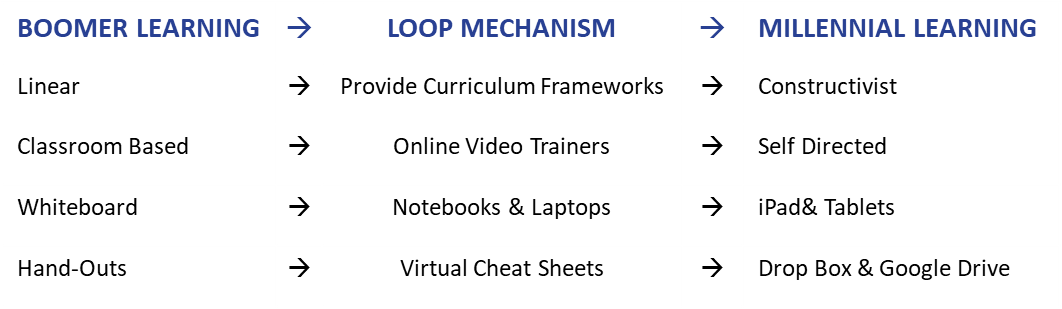
Two Birds with One Stone
Senior employees hold a wealth of valuable knowledge about the functional aspects of their jobs and vital insights into the resources, operating procedures and company dynamics of the organisations they work for. If they exit to retirement without proper succession planning strategies in place to extract and transfer their expertise, businesses may find it difficult to acclimate to the knowledge gap created by their departure.
Effectively redesigning E-Learning methodologies aimed at Baby Boomer learning, as well as the implementation of E-Learning based mentorship courses may render real economies of scale in achieving the overall Organizational Development vision of a company.

Recent Comments