
BOOM!!!!
The Silver Tsunami is upon us.
In recent timesglobal employee percentages in business have been dominated by Millennial entrants. Training Specialists are scratching their heads about most viable technology integrated Learning Management Systems to satisfy these Digital Natives’ appetite for instant learning gratification, diversification and gamification. At the other end of the spectrum, the Baby Boomers are contemplating the options of retirement or career extension. Although retiring Boomers pose a significant challenge to corporate sustainability with millions to exit the universal workforce in the next decade, those who decide to prolong their careers are the ones E-Learning Professionals should be concerned about.
The Baby Boomer generation grew up in a pre-technological environment with limited exposure to robotics and computerisation. Somewhere between 1970 and 1985 when this generation reached the prime of their careers, increasing automation and mechanisation shocked them into “analogue times” and they had to adapt to technology development, machine optimisation and of course Microsoft, Apple, Google and Amazon. Progressing to the 21st Century foreign concepts of digitisation, artificial intelligence and technology innovation in business, resulted in a “flight or fight” response from the majority of Boomers active in the workforce during the last two decades.
Customizing E-Learning for Baby Boomers
Boomers are naturally more resistant to change and hesitant to embrace the unknown which is the reason for their sense of apprehension often displayed towards new technologies and alternative training mechanisms of E-Learning practices. Training courses and methods of content execution must be developed with the aim of easing and not forcing them into unfamiliar learning territories. Furthermore, participation and engagement of a senior audience may be substantially increased if the study material and subsequent learning activities appeal to their strengths, as opposed to exposing their weaknesses.
-
Challenges
Offer them a challenging experience with an end goal to be achieved. The Boomer Generation is motivated by challenges, milestones and goals. Course materials incorporating assessments, “to do” tasks and purposeful learning outcomes will cultivate a sense of accomplishment and actualisation.
-
Interaction
Automation and self-directed learning does not resonate well with this older crowd. Including “student to trainer” and “student to student” collaboration activities like branching scenarios, will encourage them to immerse themselves in the content provided.
-
Support
Keep E-Learning course navigation straightforward and instinctive. Deliver sufficient technical assistance using online forums, FAQ pages, troubleshooting guides and contact forms as Boomers are not as tech savvy in comparison to the younger generations.
-
Recognition
Although this generation is independent and self-assured, they still require praise and acknowledgement for their efforts. Creating leaderboards or rating pages will appeal to their sense of self-worth and competitive nature. Be cautious with public feedback mechanisms and rather customise communication channels for criticism to be given privately.
A double edge sword: Why E-learning for Baby Boomers matter?
One may debate the importance of adapting E-Learning strategies for the Boomer Generation as perhaps like “an umbrella after the rain” because even those opting to prolong their careers will be lost to the business environment within the next two decades. So why even bother?
-
Opportunity Gains
Yes, maybe not the longest period to make an effort, but still it is 20 years of opportunities to upskill, develop and improve the competence of this generation to add value and stability to business. Tailoring E-Learning strategies to leverage on their fortes is crucial to ensure effective outcomes and positive results.
“The Baby Boomer Generation is hardworking, disciplined, goal orientated and thrives in challenging environments.”
-
Mentorship Advantages
Ever wondered who will be training the Nexters in 20 years from now? Probably the Millennials, correct? Now, who is teaching the Millennials at the moment? Generation X is currently in the trenches trying to keep the global economy afloat and steer corporate ships through turbulent waters of recessions, wars, climate change, volatile markets and political instability. It is time to call on the “Silver Foxes” to transfer their knowledge and experience to the M-Leaders of the future.

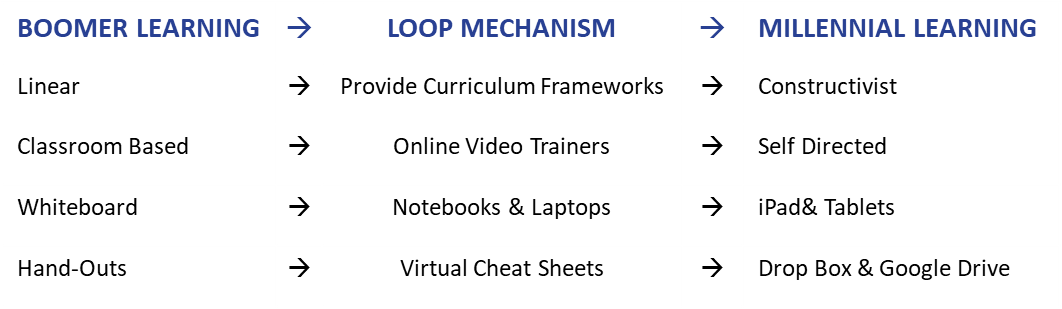
“Teach the Digital Immigrants to train the Digital Natives by creating a Learning Loop, by customising E-Learning tools to bridge the gap between the variation in generational learning styles.”
Two Birds with One Stone
Senior employees hold a wealth of valuable knowledge about the functional aspects of their jobs and vital insights into the resources, operating procedures and company dynamics of the organisations they work for. If they exit to retirement without proper succession planning strategies in place to extract and transfer their expertise, businesses may find it difficult to acclimate to the knowledge gap created by their departure.
Effectively redesigning E-Learning methodologies aimed at Baby Boomer learning, as well as the implementation of E-Learning based mentorship courses may render real economies of scale in achieving the overall Organizational Development vision of a company.
Recent Comments