

Artificial Intelligence, Augmented Reality, Machine Learning, Quantum Computers, Virtual Economies, Bots and Digital Automation are buzzwords of our current times. Whether referred to as The Fourth Industrial Revolution, The Age of Experience or The Digital Era, the way in which we conduct our professions are rapidly transforming and conforming around the singular beacon of Technology Innovation.
In an article by Jeff Bounds (Insigniam Quarterly, 2014), the prediction was made that the investment in Internet of Things (IoT) solutions for consumers, governments, and businesses worldwide, may exceed $6 trillion by the year 2020. Organizations will be the top adopters of IoT, focusing on strategies to improve their efficiency, productivity, and product offering.
Technology is reshaping business with Micro-and-Macro Machine Development policies directing decision-making in the boardrooms of the world, and Human Capital Advancement is perhaps often regarded as a mere channel to implement technology invention, as opposed to a tool for cultivating real human potential.
____________________________________
Contemplating the future necessity of training and learning ingenuities.
Will there be any human staff left to teach? Or is a robotized workforce trained by Artificial Intelligence closer on the corporate horizon than we may think?
According to a study by Mckinsey & Co, forty-five percent of humanized activities in the workplace can already be accomplished by technology automation. The traditional working environment is rapidly changing from man to machine and will have a tremendous impact on workforce operations, productivity, and profit.
Where would all this eventually transpire too? An imminent Matrix corporate environment directed by robots and a select few Homo Sapiens with superhuman brain power with the ability to absorb training in a matter of Nanoseconds. Perhaps we are not there yet, but for a “human working professional” certainly the stuff nightmares are made of.
Ellyn Shook, Chief Leadership and Human Resources Officer, at Accenture once stated: “Paradoxically, the truly human skills, from leadership to creativity, will remain highly relevant and winning organizations will strike the right balance – leveraging the best of technology to elevate, not eliminate their people.”
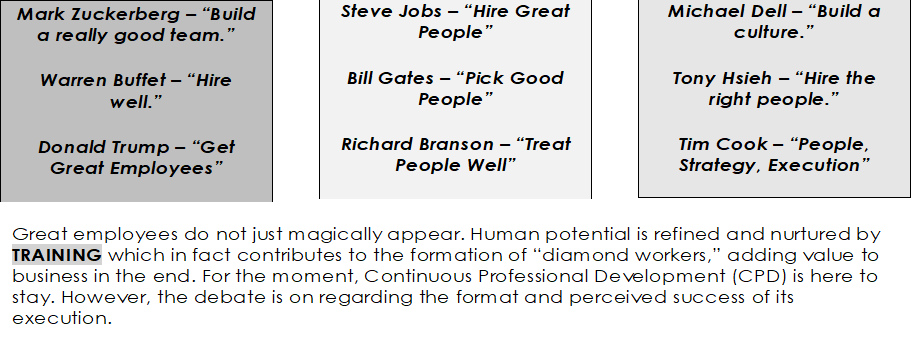
Human Capital is for the moment, is still regarded as a most valuable business asset by the Who’s Who of global business. In a Ten Rules for Success series, published by Linkedin SlideShare in 2016, the Giant Influencers of global business all cited People as an important catalyst for organizational prosperity.
Au Revoir Old School, Hello New Kid on the Block
Disruptive times call for desperate measures, and Digital Learning is widely regarded as the logical replacement to Traditional Face to Face Training and Classroom Learning. Following a Digital Learning style offers organizations the flexibility of providing on-demand learning, at a convenient time via a variety of devices to employees regardless of location and time. These practices appeal greatly to the Millennial Generation, projected to account for 75% of the global workforce by 2025.(“Millennials at Work,” PWC).
Added the significant cost saving potential of Digital Learning, adopting this method as the primary CPD strategy seems like a win-win solution for employers and employees alike. Or is this acting proverbially “penny wise, pound foolish”? Self-directed learning and around the clock accessibility of information do not ensure retention or absorption in learners. Advocates for the preservation of traditional classroom style training are raising valid concerns regarding the “stickiness” of web-based learning and the likely success rate of putting theory into practice without the aid of ILT (Instructor Led Training) activities. Learning and doing are still two very different actions the last time I checked.
Furthermore, providing employees access to online learning platforms does not guarantee completion or positive pass marks either. “Yours truly” has signed up for numerous online training courses over the years, with a sadly very negative rate of fruition. The sense of accountability created by classroom training is significantly higher than in a cloudbuilt environment.
Past, Present and Beyond 2025
Ever thought about what the state of the employee generation will be in coming 2025? Are we not creating a future workforce of digitally educated employees, but without the value of practical competence?
Traditional Training still holds water in comparison with Digital Learning when considering specific requirements, crucial to effective learning outcomes:
- Interaction & Engagement
- Personalised Feedback Channels
- Learning Objective Comprehension
- Practical Adaptation
On the flip side, Digital Learning accomplishes presently what Traditional Training was unable to achieve historically within the Continuous Professional Development industries:
- Infinite Reach
- Significant Cost Savings
- Flexibility beyond Time and Location constraints
- Economies of Scale
Jumping back from the future into the present. Today’s organizations are reminiscent of multigenerational employee compositions. A study compiled by the Harvard Business Review back in 2009 predicted our global workplace representation to include all five generations by 2015.
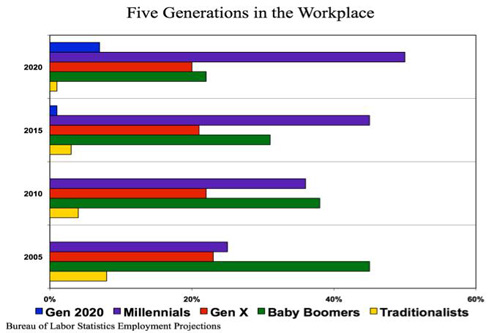
What a crystal ball moment that was! For the first time in history, we are dealing with a global workforce represented by all five generations: Traditionalists, Baby Boomers, Generation X, Millennials, and Nexters.Contrary to the popular narrative of soon to be Millennial domination, organizations are still required to cater for the other generational composites forming part of company headcount figures.
The obvious solution appears to be Blended Training: Just incorporate a multi-series of traditional and digital strategies into an LMS (Learning Management System), and you are good to go.
Not so elementary my dear Watson
The solution is not as simple as just following a hybrid training approach, but rather lies in the way that training strategies are combined and then deciding on most suitable customization in the execution thereof applicable to each generation represented within the company’s employee force.
-
Guideline 1
Training professionals should fully comprehend the specific triggers of each generation in relation to their primary channels of communication and their receptiveness of information gained via these channels.
In a nutshell: How they are trained, should resonate with how they prefer to communicate and engage with others.
A Generation X-er’s addiction to email, the Traditionalist’s preference of printed communique, the Baby Boomers desire for one on one direct interaction and the Millennials need for instant messaging, constitutes for a challenging feat in learning design and delivery. Not discarding our Generation Nexters who is just starting out their careers expecting communication channels to be optimized for continuous collaboration and instant feedback.
-
Guideline 2
Finding the sweet spot in generation learning preferences commonalities involves a proper identification of an organization’s own generational representations figures firstly. There is no need to reinvent the wheel to recognize what these preferential similarities are. A bit of targeted “Googling” and one stumble across excellent pieces of information summarising the training preferences per generation and specific behavioral traits to consider in the design and execution of training curriculums.
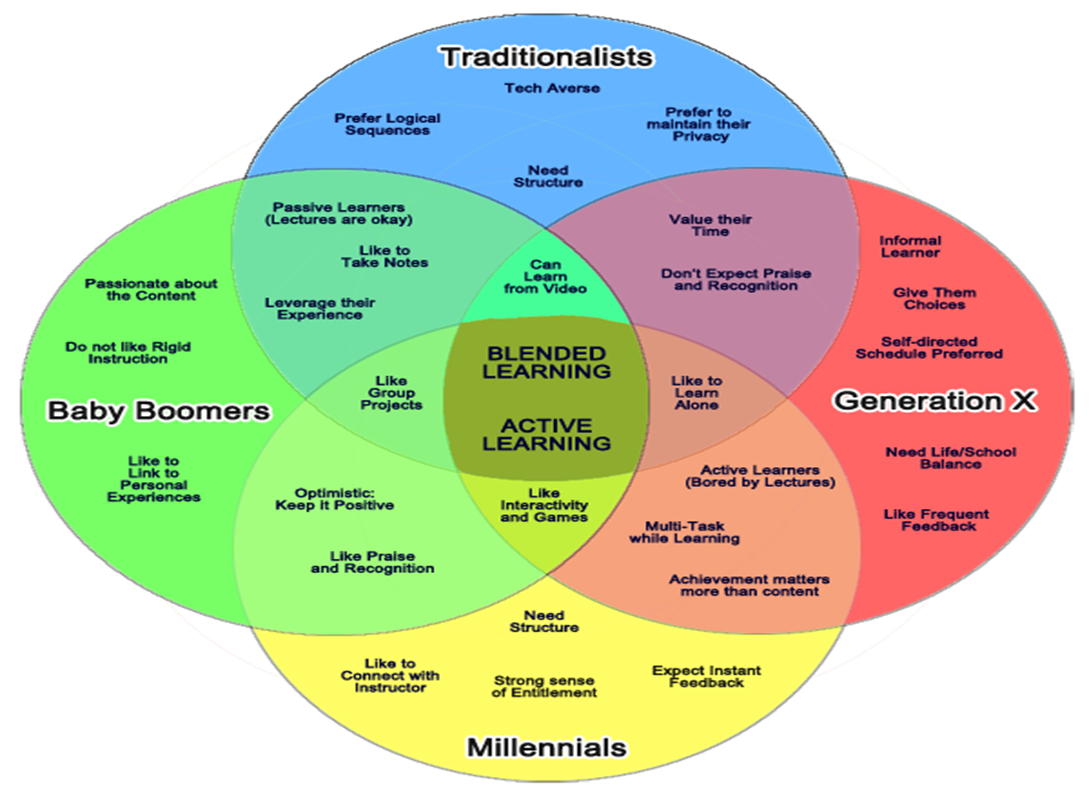
Diagram Source: Corbett, S (2008. Targeting different generations in B. Hoffman (Ed.), Encyclopedia of Educational Technology
To draw a simple example from the above figure: Traditional ILT with an online video twist or digital learning with some face to face contact may appeal to most generations forming part of your workforce. However, this is not the end of your training strategy design yet….
Listen up First World; there is a Developing World to consider too.
Factoring in employee demographics and identifying challenges pertaining to location, cultural and infrastructure barriers requires careful analysis prior to implementing learning and development initiatives. A one size fits all hybrid strategy will not be suitable if your workforce is spread across the developing nations of Latin-America, Asia, and Africa.
As a product of African origin, born on the cusp of Generation X and Millennialism, I have experienced first-hand how the anomalies evident in the various generations can blow any carefully designed training strategy out of the water. In some African countries, the Baby Boomer employees are the most Connected Generation, eager and able to partake in Digital Learning via their tablets or smartphones, but in those same countries, Millennial employees prefer a classroom or ILT Learning setup.
Training directives for the Third World, further depend mostly on the leading industries active in those countries. Due to the reduced costs of manual labor present in Developing Countries being leveraged against significant investments in infrastructure development, most employees are very hands-on working in mining or manufacturing industries. Digital Learning is perhaps not the best option when training an individual in the art of Rock Blasting, or Machinery Maintenance, where practical on the job training is crucial to learning and improving skills. Innovation in technology is happening for sure, but at a much slower rate when compared to developed nations.
Out with the Old and in with the New? Perhaps not yet.
Training purists of Digital Learning focussed plans might need to be reminded that technology cannot replace poor teaching. On the other hand, advocates of Face to Face learning methods should accept and embrace the positive effect of technology in enhancing learning outcomes.
Until we reach the stage where Hologram, Virtual Reality and Augmented Reality based training become the norm in Learning and Development practices, delivering training mechanisms with a positive rate of learner return, will require a combination of tradition and innovation as part of Continuous Professional Development tactics.


Recent Comments